
Duncanville City Directory Shelf Map
Duncanville has a short identified local telephone-directory run, not a continuous annual city-directory series. The most useful shelf list is the Dallas Public Library directory inventory dated July 22, 2025. It names the Duncanville 242 Telephone Directory for 2006, 2007, and 2007-08, and says that volume also covers Cedar Hill, DeSoto, Lancaster, and Southwest Dallas. That geography matters. A name printed in one of these books is evidence from a dated, area-wide publication, not proof that the person was inside a particular city boundary.
| Collection | Years identified | Where held | Access route |
|---|---|---|---|
| Duncanville 242 Telephone Directory | 2006, 2007, 2007-08 | Dallas Public Library History & Archives | Noncirculating reading-room material |
| Cedar Hill 141 area directories | 1954-72, plus later listed years with gaps through 2007 | Dallas Public Library | Includes Duncanville and nearby communities |
| DeSoto 235 and Lancaster 427 area books | Many years from 1956-2007, with gaps | Dallas Public Library | Area-inclusive backup shelves |
| Greater Dallas White Pages, Residence Pages | June 2007 | Portal to Texas History | Digitized page images and OCR online |
| Duncanville newspapers | 1955-2008, title dependent | Duncanville Public Library and licensed access | Library or TexShare route |
Start with the named Duncanville volume when its date fits. For an earlier period, move sideways to the Cedar Hill, DeSoto, or Lancaster books instead of assuming that no directory exists. The inventory reports gaps, so a missing year is a collection limit, not a finding about a household.
Duncanville's Local Directory Run
The 242 volume is a useful local anchor because its shelf years are known: 2006, 2007, and 2007-08. Its title also signals a wider calling and publication area. Compare the city printed beside the address and retain the volume date in every note. A phone number, street abbreviation, or spelling may be obsolete even when the printed page is clear.
The narrow local run should not be stretched into a claim of complete coverage. The library list does not establish the first printed Duncanville directory, a complete publisher history, or a final printed year. It does establish that the shelf contains these specific books. That distinction keeps family-history work honest when a person appears in one year and not another.
Note: A historical listing is a dated publication record, not proof of a current name, address, or phone connection.
Duncanville's Area Directory Shelves
For decades before the 242 run, the neighboring community books supply the practical bridge. Cedar Hill 141 includes Duncanville, DeSoto, Lancaster, and Southwest Dallas from 1954 through 1972, then at later listed points through 2007. DeSoto 235 and Lancaster 427 cover the same southwest-area setting across many years from 1956 to 2007, with gaps. Check the title page and coverage statement in the actual volume before treating any volume as a Duncanville-only list.
This pattern fits the city's record history. Early Duncanville research often belongs in Dallas County sources or in a wider regional publication. A nearby-city shelf can therefore be more useful than a modern city-name search, especially when a road, post office, or community label changed.
- Record the exact directory title and its coverage wording.
- Search surname variants and initials in the alphabetical section.
- Check the address line for a community label and street abbreviation.
- Keep a note when the volume skips a target year.
Duncanville's 2007 Directory Snapshot
The digitized Greater Dallas White Pages is a June 2007 residence-pages volume published by Southwestern Bell Telephone Company. Its 1,384 pages cover the 214, 469, and 972 area and preserve a greater-area view rather than a Duncanville city-limit file. It is useful for checking a surname, telephone number, street address, city line, and surrounding-community context from that month.
The Portal to Texas History record provides the digitized 2007 Greater Dallas White Pages source.
Use the page image beside its OCR whenever a name or address is unclear. OCR can confuse initials, abbreviations, and similar letters. The Portal record does not identify a confirmed Duncanville page for every surname, so a page number should be noted only after the image has been checked.
Reading Duncanville City Directory Entries
A directory entry is compact and its field mix varies by volume. The inspected representative digitized page can include a name, spouse or relationship in parentheses, a historic occupation field, street address, historic h/r notation, and phone number. The 2007 White Pages is simpler: household or person name, telephone number, street address, city, and nearby-city context. Treat every abbreviation as a feature of that particular volume, not as a fact that carries unchanged into other years.
| Name line | Spelling, initials, and a possible spouse or relationship parenthetical. |
|---|---|
| Historic occupation field | A period detail that can separate two people with similar names. |
| Street line | Number, street, city context, and abbreviations as printed. |
| h/r notation | Historical shorthand in some volumes; read the volume's key before interpreting it. |
| Telephone number | A date-specific contact field that may later change or disappear. |
- Criss-cross directory
- An address-ordered section that can lead from a street line to the listed household or phone entry.
- Householder index
- An alphabetical arrangement that points from a name to the printed address line.
- Abbreviation key
- The volume's explanation of short forms, often near the front; photograph or transcribe it before decoding entries.
Duncanville's Reverse Directory Method
Reverse or criss-cross searching begins with an address, not a surname. Find the city, street, and number in the address-ordered material, then return to the alphabetical pages to compare the listed name and other context. The Dallas Public Library collection does not promise a complete Duncanville reverse index for every year. Its documented shelf list and area-inclusive runs are the dependable starting point.
Use a reverse lookup as one dated clue. Street names can be abbreviated, directional words can vary, and an older book may use a nearby community label. A result is stronger when the address, initials, and an independent newspaper notice or census household all point to the same person.
Duncanville Directory and Census Pairs
City directories are usually annual and address-focused. Federal population schedules are decennial and group people into enumerated households. Federal schedules are generally available through the 72-year release practice, with 1950 available from 2022. Pair the closest directory year with the nearest released census, but do not expect the two sources to use the same address form or name spelling.
- Locate the surname and address in the best-fit directory volume.
- Write down the year, title, page or image number, and every printed initial.
- Check the nearest released census for age, relationship, and household context.
- Compare the street, community label, and spelling before joining the records.
- Use a newspaper notice, deed, or probate index to test a move, death, or successor clue.
A disappearance from a directory can reflect a move, a death, an unlisted number, or a gap in the book. It cannot identify the reason by itself. Duncanville newspaper titles offer useful endpoints: Duncanville Today runs from 1955 to 2008, Duncanville Suburban from 1960 to 2004, while other local titles cover shorter spans.
Duncanville Records Before Directories
Before a city-specific directory trail, Dallas County records carry much of the historical work. The Texas State Library Dallas County guide lists county tax rolls from 1846 to 1910, district court civil papers from 1846 to 1938, and JP inquest and death records reaching 1889 to 1969. Dallas Public Library is the local depository for these microfilm resources. Not every county record was filmed, and the state library asks researchers to work from a reel-specific request rather than an open-ended search request.
The older name trail also needs local vocabulary. Duncan Switch was the railroad-era settlement, the Nance post office was renamed Duncanville in 1882, and an 1884 commercial fire disrupted the growing town. Search those historic labels in county material and newspapers when a modern Duncanville name returns too little. Population grew from 113 in 1904 to 40,706 in 2020, a reminder that county-era material and later suburban records describe very different settings.
- 1846: Dallas County was organized, beginning the county-record context for the area.
- 1882: The Nance post office was renamed Duncanville.
- 1947: Duncanville incorporated, shifting more local activity into municipal records.
- 2006-08: The identified Duncanville 242 directory run appears on the DPL shelf list.
Note: Record the reel, volume, and image or page number because microfilm series can have unfilmed volumes or incomplete indexes.
Duncanville Archive Reading Rooms
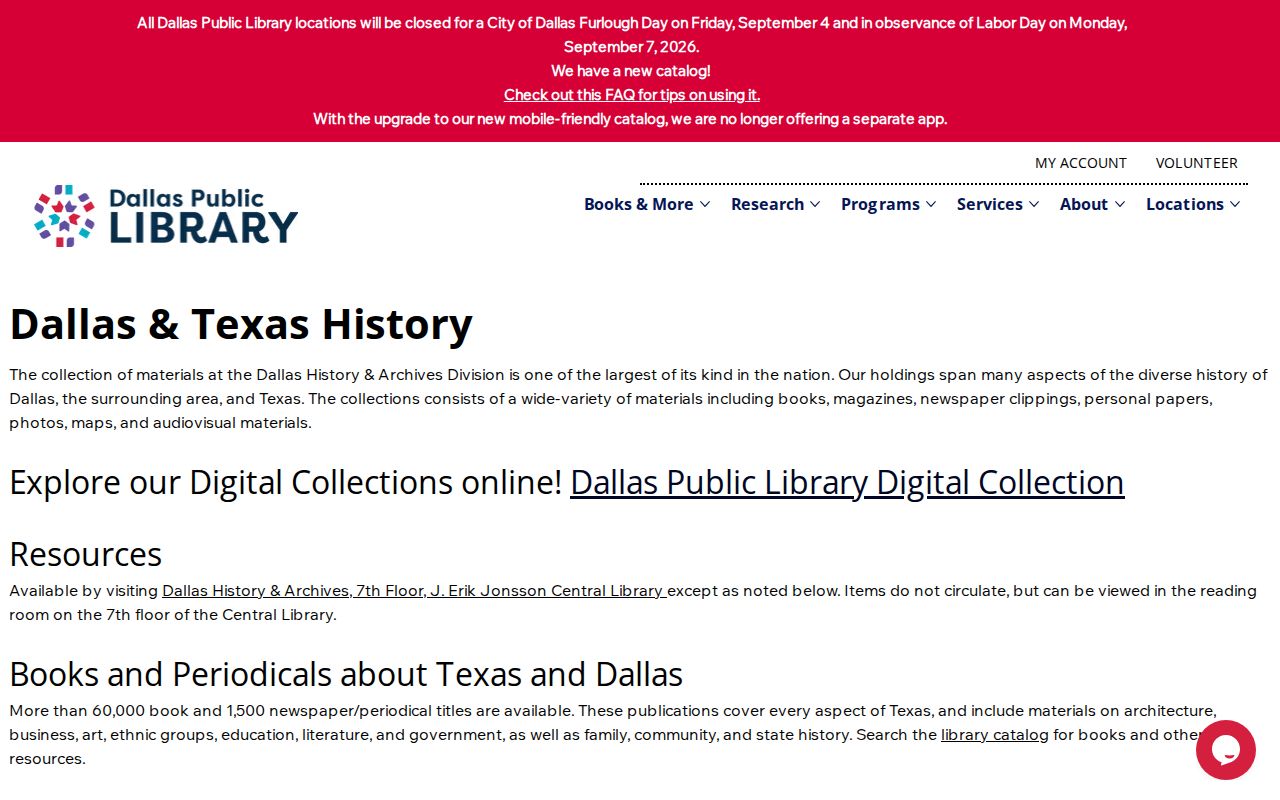
Dallas History & Archives is on the seventh floor of the J. Erik Jonsson Central Library, 1515 Young Street in Dallas. Its directories, newspapers, maps, property-ownership maps, and county microfilm are noncirculating and are viewed in the reading room. The collection reports more than 60,000 books, 1,500 newspaper and periodical titles, roughly 1,500 print or microfilm newspapers, and more than a million photographs. Contact listed by the library: 214-670-1435 or texas@dallas.gov.
The Dallas History & Archives collection page identifies the reading-room sources used for Duncanville city directory research.
Bring the exact directory title, surname, address, and approximate year. Those details help staff point to a shelf, newspaper run, map, or microfilm reel without turning a focused request into a search for a living person.
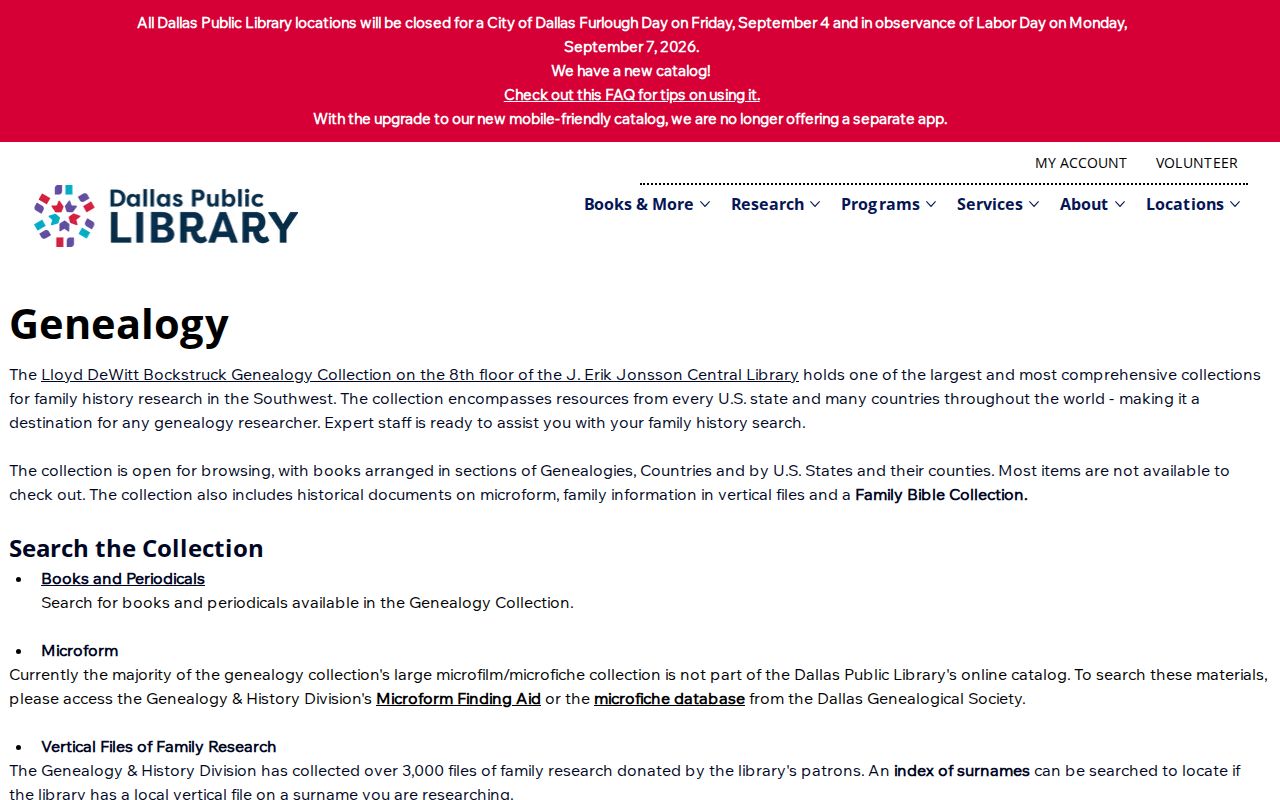
The eighth-floor Bockstruck Genealogy Collection adds open browsing, more than 3,000 surname vertical files, historical documents on microform, a Family Bible Collection, and books organized by family, country, state, and county. Its listed genealogy contact is 214-670-1433 or genealogy@dallas.gov; most material is noncirculating.
The Bockstruck Genealogy Collection page shows the companion sources for Duncanville city directory work.
Surname files, yearbooks, and licensed databases can help test a family connection after a directory name is found. They do not convert a historical listing into a current contact record.
Dallas Historical Society Archives
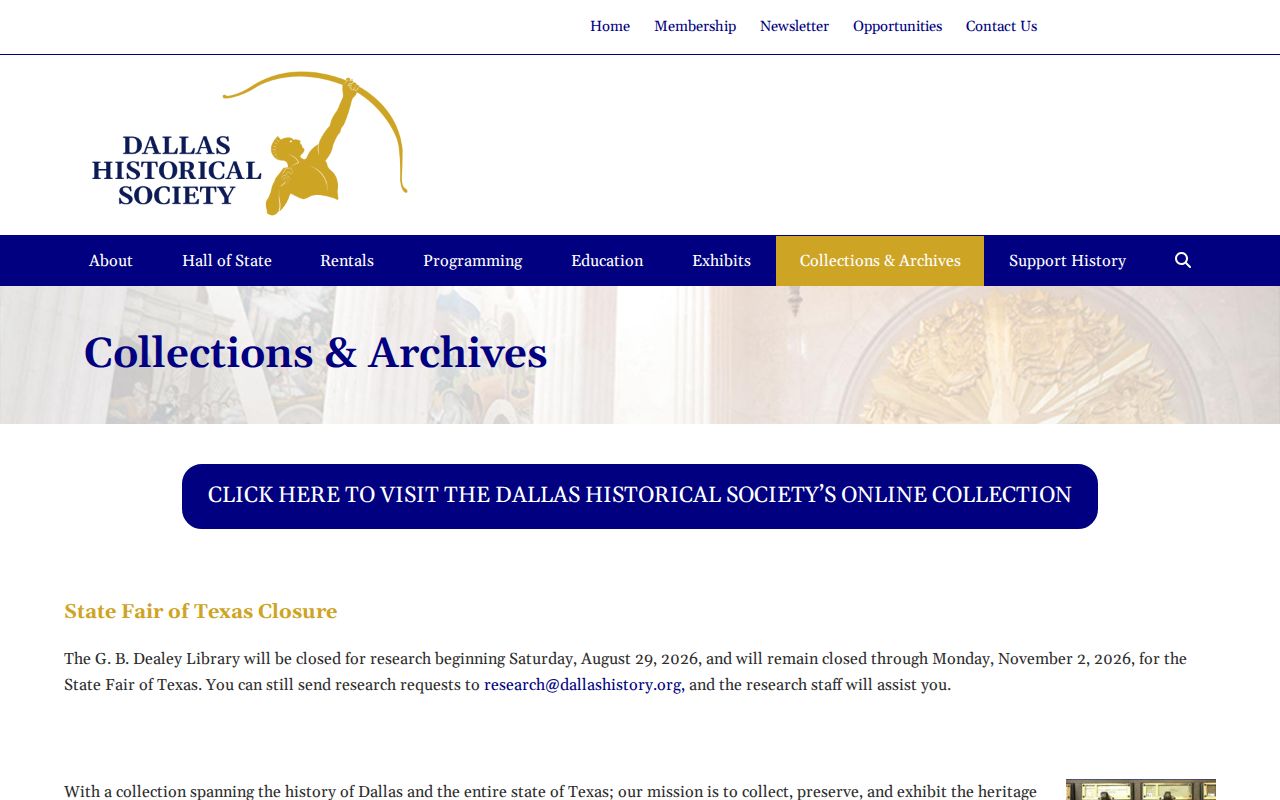
The Dallas Historical Society collections offer a second archival channel for photographs, documents, artifacts, books, periodicals, and papers relating to Dallas, Dallas County, and Texas. The Hall of State location at Fair Park is appointment-only for research, Tuesday through Friday from 10 to 4. Staff answer questions requiring up to 15 minutes of work without charge; more extensive research and reproductions can involve fees and advance approval.
The Dallas Historical Society collections page describes the appointment archive available for Duncanville city directory context.
Ask about a defined person, organization, event, year, or Dallas County connection. The archive has broad regional holdings, but it does not promise a Duncanville resident roster or a house file for every address.