
Find Addresses Along Duncanville Streets
For a named Duncanville street, begin with the physical address rather than a name alone. The Dallas Central Appraisal District eSearch record gives the current property account, site address, owner name, mailing address, and legal-description fields. It is an ownership and tax-record anchor. It does not establish every person who may be at that address. From there, the county deed index supplies transfer details, while official election channels may confirm a single registration status or provide lawfully requested file data. Historical directories add a dated address snapshot when the question concerns an earlier period.
- Enter the address in DCAD and save the account number, situs address, subdivision, lot or block, and both legal-description lines. The situs is the physical parcel address.
- Read the assessed owner and tax-mailing address on the same DCAD account, while keeping both separate from the physical situs address.
- Search that owner as a grantee in the Dallas County Official Public Records index. Compare the deed's legal description before deciding it belongs to the same Duncanville property.
- Use the Dallas County voter-status route for an official individual status check. A street-wide voter file is a separate formal request, not a public browse list.
- For a past address snapshot, consult the Dallas Public Library directory and newspaper holdings. A historic entry is dated evidence, not proof of a present household.
The sequence is address, owner, deed, permitted voter information, then dated directory evidence. It keeps a street search grounded in records that each answer a narrow question instead of blending property ownership with occupancy.
Duncanville Street Range Search
DCAD is the practical starting point for a block or a long stretch of a Duncanville street. Its Street Address mode accepts an address number, direction, street name, building, suite, and city. For a range, use the From and To boxes. DCAD advises using at least two street-name characters, leaving out the street type, entering no spaces in a street-name query, and using the percent sign as a wildcard when needed. Account Type can narrow results to Residential, Commercial, or BPP records. A street search should be retried with fewer components when an exact version fails.
The official DCAD address-search screen shows the controls used for street-range review.
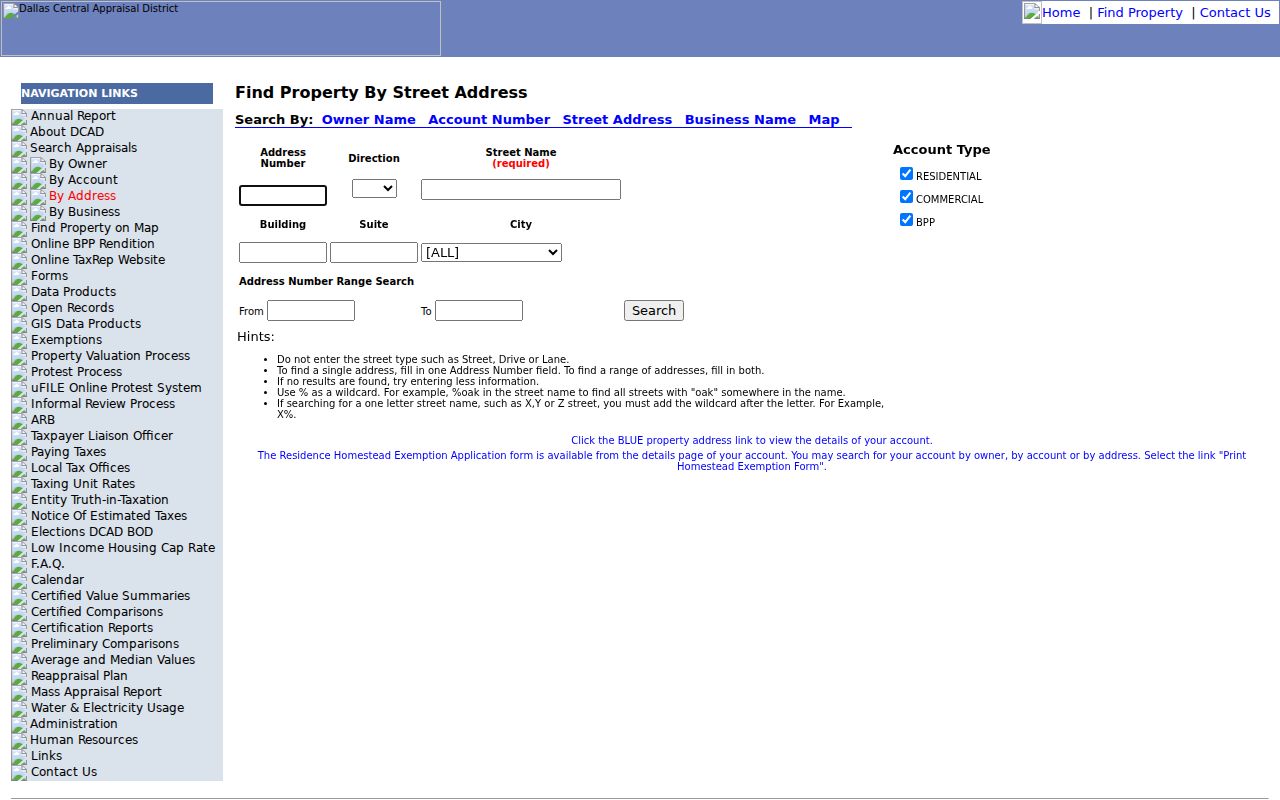
Use one number for a single property and From/To only when reviewing a street segment. The result card can show a property account, legal description, map grid, jurisdiction, values, exemptions, and owner and mailing fields. Record the account number with the address because it is more stable than a street spelling alone.
| DCAD field | Input | When it matters |
|---|---|---|
| Address Number | Numbers only | Required for a single-address search |
| Street Name | Text, two or more characters | Omit the street type; use % for a wildcard |
| Direction and City | Dropdown selections | Useful when similar street names appear |
| From and To | Number pair | Use for a Duncanville street range |
| Account Type | Residential, Commercial, BPP | Limits the class of account returned |
Note: DCAD's searchable account card is a tax-record view, so a match identifies the assessed owner rather than every person connected with an address.
Duncanville Parcel Map for Street Work
The DCAD map turns a text result into a spatial check. Choose Account/Prop Addr/Owner Name as the search feature type, enter a whole or partial property address, then choose the correct result from the list. Other feature types include subdivision or condominium, survey abstract, map grid, Dallas block, and neighborhood. Those alternatives help when a Duncanville address has a directional difference, a suffix mismatch, or a deed that supplies only a legal description.
After selecting a parcel, use Legend, Locate, Switch Basemap, and the Create Property Map or Report controls to preserve a clear source view. Measure Length and Area can help describe a custom block, but neither turns the map into a survey. The city’s interactive map collection adds zoning, council district, land-use, flood, stormwater, parks, and utility context. Those layers explain jurisdiction and geography, not who is present at an address.
A visible parcel can be a common tract, vacant land, a multi-unit property, or a non-residential site. Check the account type, legal description, and plat before calling every polygon a household on a Duncanville street.
Note: DCAD labels its map informational and approximate, so preserve the account card and legal description when a boundary is unclear.
Duncanville Street Records Coverage
Address-keyed sources do not carry the same kind of evidence. The table below keeps the key distinctions visible. DCAD supplies the current appraisal account. Dallas County records establish recorded transfers and plats. City permit material is a project record. Election data has its own disclosure rules. Older directory material can place a name at an address for a particular publication date, but should not be read as a current roll.
| Address record | Custodian | What it can establish | Access route |
|---|---|---|---|
| Appraisal account | DCAD | Owner, situs and mailing address, account, legal description | Free eSearch or parcel map |
| Parcel map | DCAD | Parcel geometry, map grid, neighborhood, selected account | Free map, approximate boundaries |
| Official Public Record | Dallas County Clerk | Grantor, grantee, date, instrument, and legal description | Index, copy request, or counter |
| Permit or planning record | City of Duncanville | Location, project roles, status, inspection activity | Citizen Access or city records route |
| Voter record | Texas and Dallas County elections offices | Permitted registration and participation fields | Status lookup or formal request |
| Historic directory | Dallas Public Library and digitized collections | Dated address, name, phone, and directory notation | Library or collection access |
The account number and legal description are the best bridge between these records. Street text can change in punctuation, direction, or type. A deed may omit a modern street number altogether, while a plat, lot, block, or survey abstract carries the continuity needed for a reliable address-record trail.
Trace Duncanville Street Deed Links
Use DCAD’s current owner and legal description to enter the Dallas County Official Public Records search. Select property records, search the owner as grantee, and use recorded-date limits when a common name creates too many results. Capture the seller, buyer, recording date, instrument number, document type, and legal description. Then search the seller as a grantee to move backward. Do not treat a lien, release, deed of trust, correction, or plat as a transfer without reading the document type.
The county-linked deed-index interface separates department, search term, date range, and Index Only or Index & Full Text OCR choices.
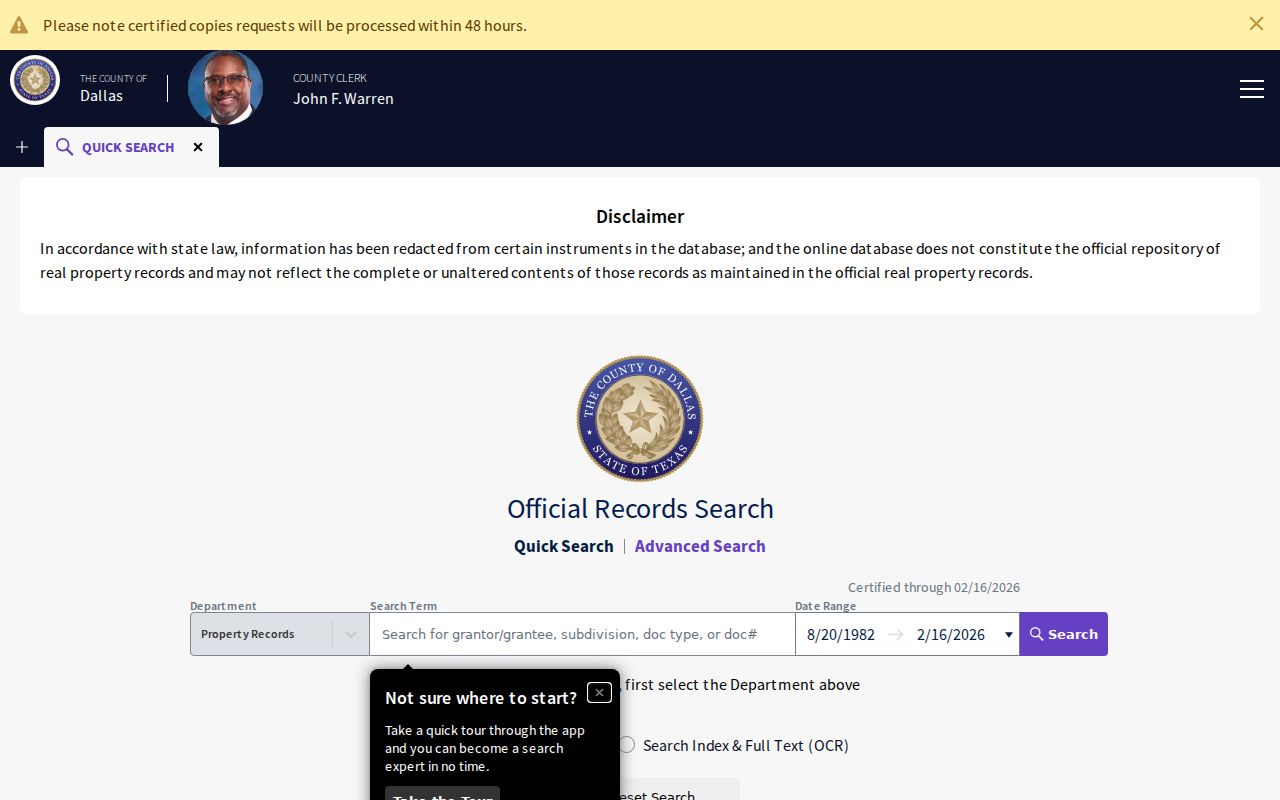
Index access and a usable document copy are different steps. The County Clerk’s request form supports recorded name, instrument number, document type, property address, and city, state, and ZIP. It lists plain copies at $1 per page and certified copies at $1 per page plus $5 certification per document. The county says its records reach back to 1846, but the online index cutoff was not located in the official sources. When a link is missing online, use the counter, a mail request, library or archive microfilm, or a targeted public-information request for an existing county record.
Note: Because no official online cutoff was located, a missing result can signal another access channel rather than a missing county record.
Duncanville Street Permit Evidence
Duncanville Citizen Access is the city’s address-keyed planning and permitting route. Its application workflow starts with Locations, then Type, Contacts, More Info, Attachments, Signature, and Review and Submit. A location can be found by the map bar or a pin. The system can associate Applicant, Contractor, and Owner roles with a permit, together with permit number, status, inspection workflow, scheduled time, comments, checklist material, and inspector notes.
That evidence can date a construction or alteration project along a Duncanville street. It does not establish a current household. Registration is required to apply or track a request, and research did not locate a public historical-coverage cutoff. If the public portion does not answer a narrow records question, ask the city for an existing record by address, record type, and date range under the Texas Public Information Act.
Note: A permit contact may be an applicant or contractor, so keep that role separate from a property owner and never infer residency from it.
Duncanville Street Voter Access
Texas offers a public-facing voter-status route through VoteTexas and Dallas County Elections, but that individual workflow is not a list of everyone on a block. The complete state voter-file request has permanent street components, mailing fields, ZIP, status, and participation history. It requires a notarized affidavit, a $75 deposit, and a noncommercial-use promise. A requester can narrow a file by county, precinct, election, status, or other form options. The law does not reveal ballot choice, and Texas does not maintain ordinary permanent party registration.
The Dallas County voter-status page is the official starting point for one record. Its live labels are dynamic, so use the current screen rather than relying on a copied field list.
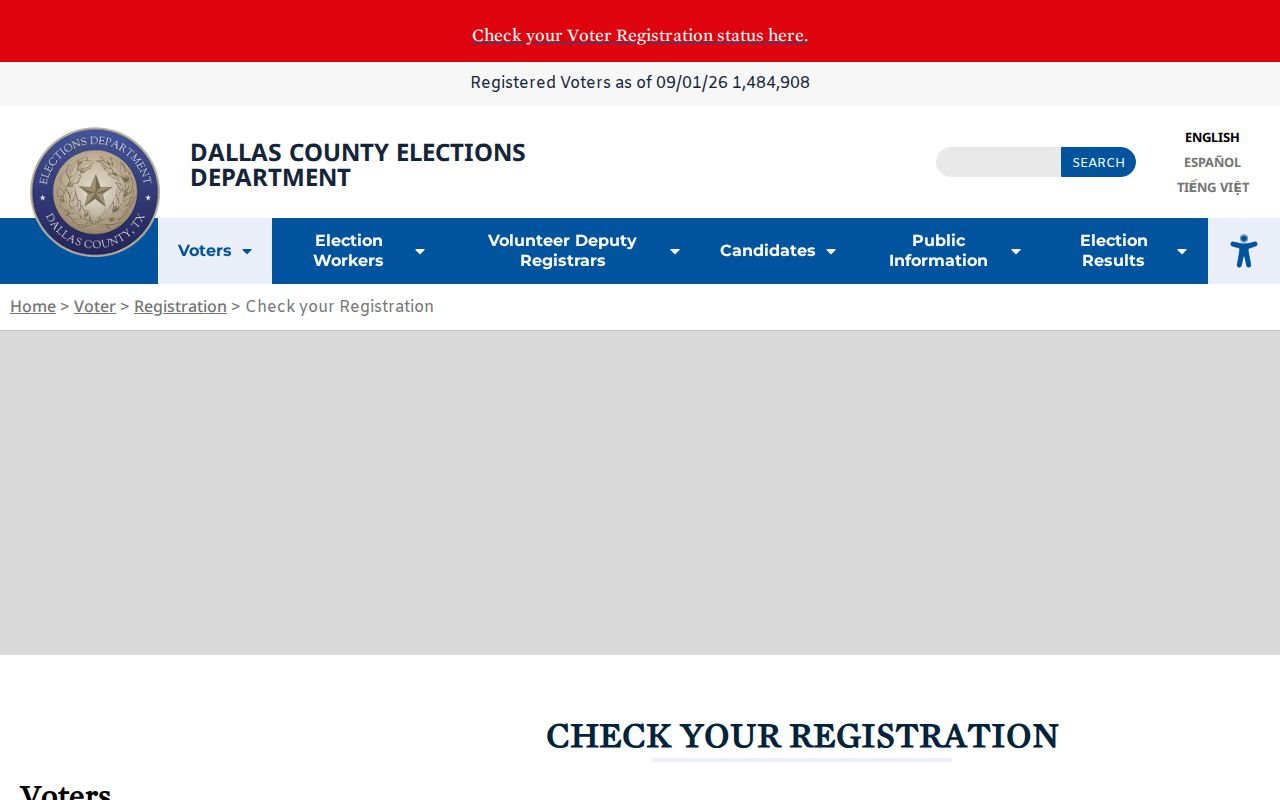
For a lawful formal file request, the Texas Secretary of State request form states the delivery choices and required affidavit. Treat a permanent address, mailing address, status, and election-history field as distinct. Protected categories may have address information withheld or replaced.
Duncanville Historical Street Addresses
For older addresses, the historical layer is a library task. Dallas Public Library lists Duncanville 242 telephone books for 2006, 2007, and 2007–08. Its area directories provide a wider bridge: the Cedar Hill 141 run includes 1954–72 and selected later years, while DeSoto and Lancaster books can include the same regional address geography. The digitized June 2007 Greater Dallas White Pages gives an additional name, telephone, and address snapshot. Search a nearby-city volume when a Duncanville-specific book is unavailable.
Directory abbreviations need care. An entry can include a spouse or relationship parenthetical, occupation, address, phone, and historical “h” or “r” notation. It is a time-stamped publication convention, not a present-day property status. The historical collections and their access routes are described on the Duncanville City Directory page, where a reader can follow one dated entry across multiple years.
Before incorporation, Duncanville research may appear under older local names. The settlement was associated with Crawford Trees, the railroad-era Duncan Switch, and the Nance post office before the 1882 Duncanville name. A modern place-name-only search can miss early Dallas County material, so preserve the exact historical label and legal description beside any old street reference.
Duncanville Address Terms to Keep Separate
Address records use similar words for different things. Keeping each term distinct prevents a Duncanville street search from jumping from a tax contact to a conclusion about a person. The DCAD account card and the recorded deed usually supply enough detail to make the distinction.
- Parcel
- A mapped property account or tract. Its boundary on the DCAD map is informational and should be checked against the legal record when precision matters.
- Situs address
- The physical property address supplied to DCAD. It can differ from the owner’s tax-mailing address.
- Plat
- A recorded map that can connect a street location to a subdivision, lot, block, or other legal description.
- Legal description
- The lot, block, subdivision, survey abstract, or related land description used to identify property in deeds and records.
- Criss-cross directory
- A reverse address directory that organizes a dated publication from address to listed name rather than from name to address.
When a newer account has a lot number before the municipality supplies a house number, the legal description and map grid may be more useful than the street line. This is also why a nonmatching mailing address is not proof that a different person owns the parcel.
Limits of Duncanville Street Records
A property owner is not automatically the person present at an address. An owner can use a separate tax-mailing address, hold property through a trust, or have an administrative contact. Household members, visitors, utility customers, delivery details, and motor-vehicle address data are not a public street list. The federal Driver’s Privacy Protection Act restricts DMV personal information. A protected voter or Texas Address Confidentiality Program participant can have a substitute or withheld address even where another record series is public.
Texas public-information law concerns existing records held by a government body and allows exceptions for confidential or protected material. Ask a custodian for a specific record, date range, and format. Do not ask an office to assemble a person profile from unrelated records. A missing match is not proof that a person was never associated with a Duncanville address.
Lawful use. Use Duncanville address records for personal, lawful research and never to stalk, harass, intimidate, or expose a protected person. Texas Penal Code §§42.072 and 42.07 address stalking and harassment.
Duncanville Street Record Fallbacks
Online results do not make a complete county file. Dallas County says records begin with the county’s 1846 establishment, while the online index’s historical cutoff was not located. The Dallas County records hub routes researchers to the County Clerk systems, and current service notices can affect counter or email availability. The Recording Division is at 500 Elm Street, Suite 2100, Dallas, and lists 214-653-7099; call before travel because service conditions can change.
For a missing older deed or plat, use the County Clerk counter or mail request, then the Dallas Public Library and Texas State Library and Archives Commission microfilm routes. A focused Texas Public Information Act request should identify the custodian, record series, property address or legal description, date range, desired format, and a request for any fee estimate. These channels are better than guessing an online coverage year or treating a search miss as a historical conclusion.